





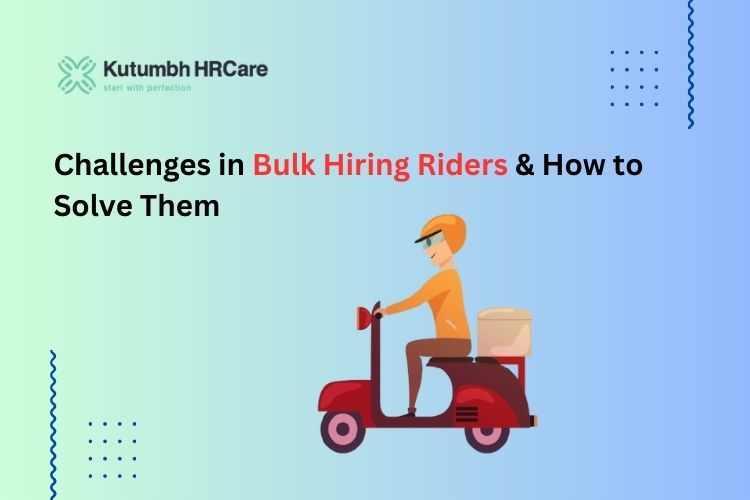
Recruiting thousands of delivery partners simultaneously, often referred to as bulk hiring riders, is a beast of its own. It differs fundamentally from corporate hiring in its velocity, volume, and volatility. This internal blog delves into the core challenges operational leaders and HR heads face in this arena and outlines how modern bulk hiring services and strategic innovations are solving them. The specific friction points in bulk hiring riders can paralyze a fleet's expansion plans if not addressed with precision.
Core Challenges in Bulk Hiring Riders
The Volume vs. Quality Paradox
The most immediate challenge in bulk hiring services is managing the deluge of applications without compromising on candidate quality. When you need to hire 500 riders in a week, manually screening thousands of applications is impossible.
The "Ghosting" Epidemic and High Attrition.
In the gig economy, candidate commitment is fluid. This "no-show" rate can be as high as 50-60% in manual processes.
Early Attrition: New hires often leave within the first 30 days if expectations regarding earnings or workload are not met, creating a "leaky bucket" where recruitment teams are constantly backfilling rather than expanding.
To overcome these hurdles, companies must move away from manual spreadsheets and reactive hiring. The solution lies in a mix of advanced technology, process re-engineering, and leveraging specialized bulk hiring services.
Implement a "Liquid Workforce" via Bulk Hiring Services
Strategic Outsourcing: Partnering with bulk hiring services allows companies to scale fleets by 300% for peak seasons (like festival sales) and scale back without legal liability.
Pre-Vetted Talent Clouds: Agencies maintain active databases (Talent Clouds) of pre-verified riders, enabling deployment in 48–72 hours compared to 14 days for internal teams.
The "New Age" Challenges in Bulk Hiring Riders
Algorithmic Ghosting & Competition: In a candidate-centric 2026 market, riders often use AI to apply for dozens of roles simultaneously. If an employer’s response isn't near-instant, they lose the candidate to a faster competitor.
Implement Hyper-Automation & Agentic AI
Conversational UI: Recruiters in 2026 use "Agentic AI" assistants that can reason and execute tasks—such as drafting personalized outreach or summarizing candidate strengths through natural language commands.
Asynchronous Evaluation: One-way video interviews and AI-driven skill tests allow for the evaluation of thousands of candidates simultaneously, reducing time-to-hire by up to 90%.
Instant Verification: Verification of licenses and background checks is now integrated into the applicant tracking system (ATS), allowing for same-day document clearing.
Strategic Use of Bulk Hiring Services
Ready-to-Deploy Talent Clouds: Modern bulk hiring services maintain "warm" talent ecosystems of pre-vetted riders across various geographies, enabling rapid deployment in 48–72 hours.
Scalability for Peak Spikes: Specialized agencies provide the elasticity to scale fleets for seasonal surges (like festive sales) and then scale back, managing the administrative burden of high-volume payroll and legal compliance.
Front-Loading Retention
Realistic Expectations: High attrition is often solved by "front-loading" retention using 13-question suitability surveys to filter for mindset and accountability before the first interview.
Tenure-Based Incentives: Moving away from purely performance-based raises, some 2026 leaders offer automatic tenure bumps (e.g., a 1.2% raise every 3–6 months) to reward and retain long-term partners.
Digital Onboarding: Implementing "buddy systems" and micro-learning modules via mobile apps helps new riders feel supported and informed before their first route, significantly reducing "no-shows."
Hybrid Fleet Models
Elastic Outer Rings: Companies are moving away from "internal-only" fleets toward hybrid models. They keep a core internal fleet for brand-defining deliveries while using a vetted network of external carriers for overflow volume and new geographies.
To sustain this growth, companies are moving away from manual hiring toward integrated bulk hiring services and advanced AI technologies.
Primary Challenges in Bulk Hiring Riders.
Deploy "Front-Loaded" Retention
Instead of just hiring for volume, successful firms use "front-loading" strategies to filter for long-term fit from day one.
Automated Suitability Surveys: Use short, 10–15 question multiple-choice surveys to score candidates on accountability and commitment before an interview.
Transparent Job Ads: Avoid exaggerating pay or hours. Providing a realistic view of the work ensures only those truly interested in the role as-is enter the pipeline.
In 2026, bulk hiring riders has evolved from a seasonal necessity into a year-round "perpetual recruitment" engine, especially as India's gig economy is expected to add 2 million additional workers this year alone.
Below are the unique 2026 challenges and the innovative solutions modern bulk hiring services are deploying to solve them.
The 2026 Challenge Landscape
The "90-Day Cliff" Attrition: Most rider attrition now happens within the first three months. By Day 90, many new hires decide if they see a future with the company; if they don't, they leave for a competitor with better "tech-as-a-benefit".
Algorithmic Ghosting: With riders using AI to apply for dozens of roles at once, they prioritize the first company that responds. A delay of just a few hours often results in the candidate "ghosting" the recruiter.
Hyper-Local "Tier-2" Expansion: Quick-commerce is rapidly moving into Tier-2 and Tier-3 cities. Finding thousands of riders with valid documentation in these newer markets is a logistical strain for centralized HR teams
Compliance Under the 2026 Social Security Code: New regulations require formal social security (PF/ESI) for gig workers. Managing this paperwork for a massive, high-turnover fleet is a significant administrative burden.
1. Implement "Agentic AI" for Near-Instant Hiring.
To beat "algorithmic ghosting," leading firms use agentic AI that doesn't just screen but actively manages the candidate.
24/7 Virtual Assistants: AI-powered chatbots on platforms like WhatsApp handle the entire cycle from initial screening and digital ID verification to scheduling a "preview day" within minutes of an application.
Mobile-First "One-Click" Apply: Abandon desktop-heavy forms. Shifting to WhatsApp-based applications can reduce drop-off rates and lower cost-per-hire.
2. Leverage "Hybrid Elastic Capacity" via Outsourcing
Forward-thinking logistics leaders are abandoning the "internal-only" fleet model for a hybrid approach.
Specialized Bulk Hiring Partners: Organizations partner with bulk hiring services to maintain an "elastic outer ring" of capacity. These agencies keep pre-vetted "Talent Clouds" ready to deploy for peak surges like festival sales or to fill new Tier-2 city nodes in 48–72 hours.
RPO (Recruitment Process Outsourcing): By outsourcing the high-volume cycle, internal HR can focus on culture and leadership while the partner handles the mass BGV, compliance, and payroll.
3. Shift from "Onboarding" to "Pre-boarding" Retention.
Retention in 2026 starts the moment the rider accepts the offer, not on their first shift.
Pre-boarding Engagement: Send personalized welcome videos from the fleet manager and provide early access to a "buddy" via team chat. This builds a sense of belonging and reduces the 58% offer-rejection rate seen in slower systems.
Realistic Role Previews: Use short "Role Reality" videos in the application flow. Candidates who understand the physical demands and the "tech stack" they will use are 25% less likely to quit in the first month.
4. Data-Driven "Stay Rate" Metrics.
Recruiters are now being measured on "stay rates" at 90 and 180 days rather than just "filled rates."
Predictive Analytics: Use AI to analyze the traits of long-tenured riders and prioritize candidates with similar profiles (e.g., specific proximity to delivery hubs or prior experience with similar tech tools).
Tenure-Based Bumps: Instead of only performance bonuses, implement automatic pay increments at the 90-day mark to flatten the "90-day cliff."

Kutumbh HRCare is a manpower solution enterprise serving fortune 500 Clients.
2025 © All Rights Reserved by Kutumbh HRCare Private Limited
CIN: U74900DL2018PTC334097